A dental CBCT scan creates a 3D view of your teeth, jawbone, and nearby nerves. Regular X-rays show flat images, so some problems stay hidden. These include infections at the root tip, extra canals, and small cracks. At Toothsavers in Boca Raton, we use CBCT to find what flat X-rays can't show.“The scan captures detailed …

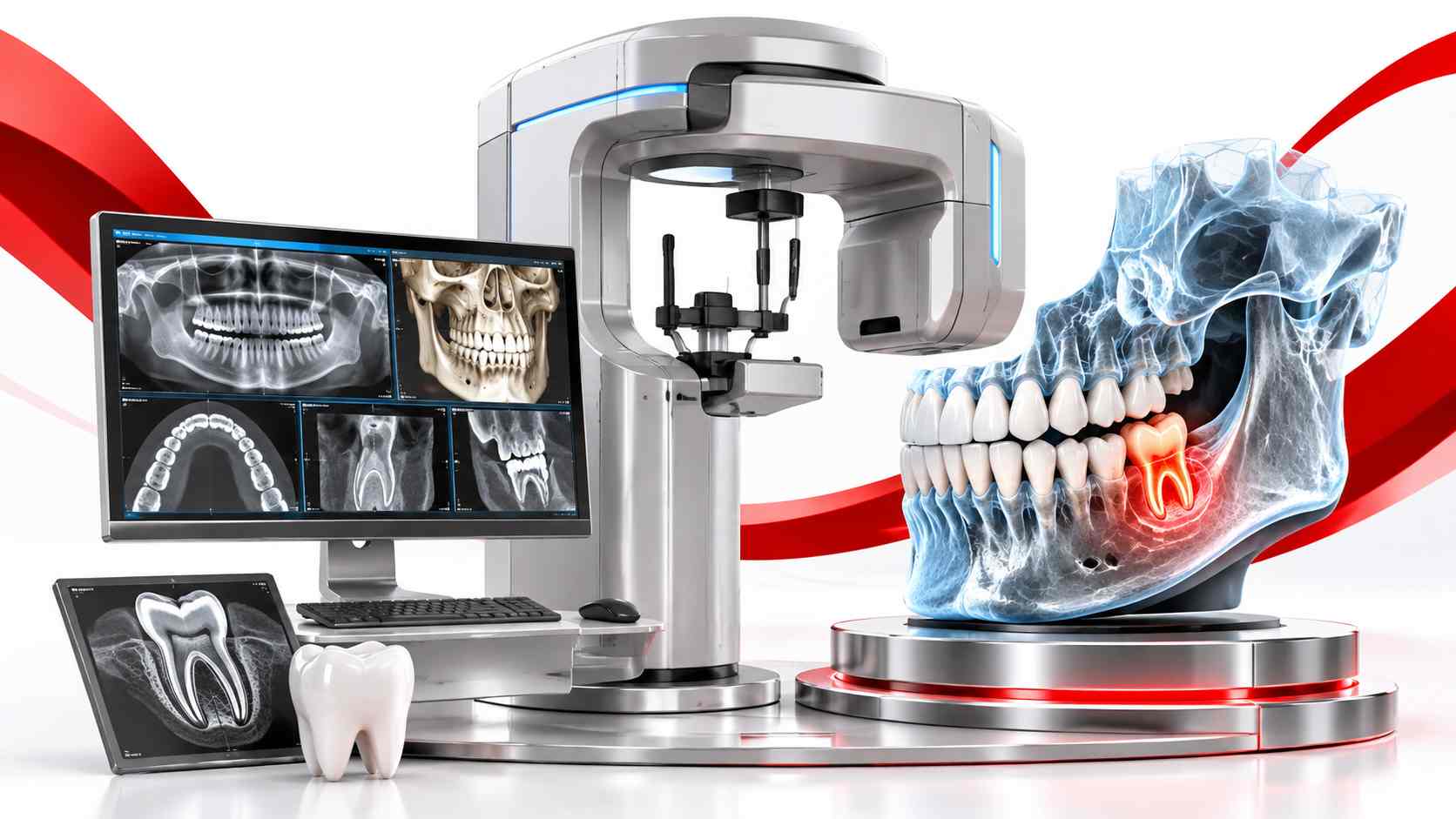
A dental CBCT scan creates a 3D view of your teeth, jawbone, and nearby nerves. Regular X-rays show flat images, so some problems stay hidden. These include infections at the root tip, extra canals, and small cracks.
At Toothsavers in Boca Raton, we use CBCT to find what flat X-rays can’t show.“The scan captures detailed images from multiple angles, often within seconds. This helps me pinpoint the cause of your pain and plan the right treatment.
Not every patient needs a CBCT scan. we recommend one when a regular X-ray cannot answer the question, such as persistent pain after root canal treatment or planning an implant. The scan needs no special preparation and uses a low radiation dose.
What Is a Dental CBCT Scan?
A dental CBCT scan is a 3D X-ray of your teeth, jaws, and nerves. CBCT stands for cone beam computed tomography. The scanner rotates around your head and captures multiple images, which a computer combines into a 3D view. A computer builds these images into one detailed 3D model.
Standard dental X-rays, such as bitewings and panoramic films, only show flat, two-dimensional pictures of the teeth. A CBCT scan creates detailed 3D images, showing a complete view of the tooth, its roots, and the surrounding bone.We can turn the model and view each tooth from the front, side, and top. This can reveal details such as curved roots, the position of the lower jaw nerve, and the sinus floor.
The scan is fast, painless, and nothing enters your body. In most cases, we can review the images during the same visit.
One scan shows these key areas:
- Teeth, such as molars with curved or extra roots
- Jawbones, like the upper jaw (maxilla) and lower jaw (mandible)
- Nerves, such as the inferior alveolar nerve in your lower jaw
- Sinuses, like the maxillary sinus above your upper back teeth
- Jaw joints, known as the temporomandibular joints (TMJ)Dental CBCT vs. Regular X-Rays and Medical CT
CBCT vs. Regular Dental X-Rays and Medical CT
A dental CBCT scan shows your teeth and jaw in 3D, while a regular X-ray shows them flat. A medical CT is also 3D, but it covers more of the body. CBCT is built for teeth and bone.
On flat X-rays, like bitewings and panoramic films, structures overlap. One root may overlap another on a flat X-ray. CBCT removes this overlap, so we can measure bone and trace each canal.
Medical CT is generally better suited to evaluating many soft-tissue structures. CBCT does not replace regular X-rays. For cavity checks, bitewings remain the right tool.
What Can a Dental CBCT Scan Detect?
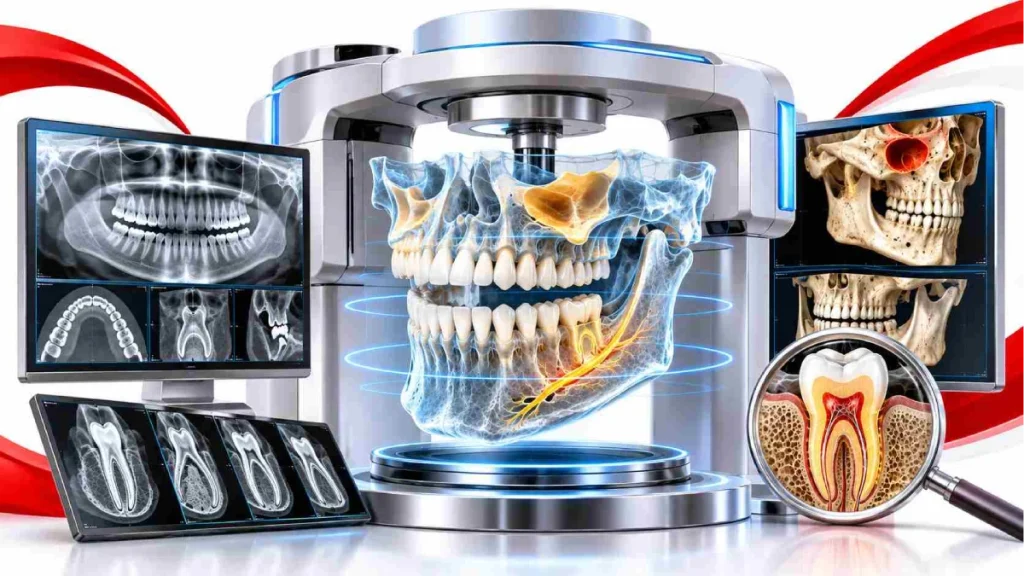
A dental CBCT scan can detect hidden infections, cracked roots, bone loss, and cysts that flat X-rays may miss. It also shows how close your teeth sit to nerves and sinuses. Here is what we check on a scan:
- Infections, like abscesses at the tip of a root
- Fractures, such as cracks that run down the root
- Extra canals, like the second canal (MB2) in upper molars
- Bone loss, around a tooth or in a gap before an implant
- A CBCT scan can show the location and extent of a lesion, but imaging alone cannot always confirm whether it is a cyst or another type of growth.
- Root resorption, where the body breaks down part of a root
A 2008 study published in the Journal of Endodontics found that CBCT revealed 34% more lesions than conventional periapical X-rays in the examined upper back teeth. This shows how 3D imaging can provide additional information when regular X-rays do not explain a patient’s symptoms.
However, no scan finds everything. Metal crowns and fillings can cause streaks that hide thin cracks. We read every scan together with your symptoms and clinical exam.
How Dentists Use CBCT Scans for Treatment Planning
Dentists use a dental CBCT scan to plan implants, root canals, wisdom tooth removal, and jaw treatment. The scan shows bone, roots, and nerves before treatment starts. This helps avoid surprises during the procedure.
Dental Implant Planning
A CBCT scan helps assess the available bone height, width, and anatomy at the implant site.We assess the available bone height, width, and surrounding anatomy at the planned implant site. The scan marks nearby structures, like the inferior alveolar nerve and the maxillary sinus.
With this data, we plan the implant’s size, angle, and depth on a computer.The plan can also support computer-guided implant surgery when appropriate. If bone is thin, the scan shows if you need a bone graft or sinus lift first.
Root Canal Treatment
A CBCT scan helps me examine root anatomy, identify additional canals, and investigate possible root fractures that regular X-rays may not reveal. Some teeth have extra canals that flat X-rays cannot show. A common example is the second canal (MB2) in upper first molars.
According to a 2018 worldwide study in the Journal of Endodontics, 73.8% of upper first molars had an MB2 canal on CBCT.“If this canal is missed, infection and pain can return. When patients report continued pain after root canal therapy, we turn to CBCT imaging for further evaluation.
Wisdom Teeth and Oral Surgery
A CBCT scan shows how close a wisdom tooth sits to the nerve in your lower jaw. This nerve, the inferior alveolar nerve, gives feeling to your lip and chin. Panoramic X-rays show the tooth and nerve overlapping, but not their true distance.
When a wisdom tooth appears close to the nerve, CBCT can help the surgeon understand their relationship and consider an appropriate surgical approach, such as coronectomy.
Jaw and TMJ Problems
A CBCT scan shows the bones of your jaw joint, called the temporomandibular joint (TMJ). It can reveal changes, like worn joint surfaces, bone spurs, or arthritis. This can help evaluate bony changes when you have jaw pain or suspected TMJ-related bone problems.
However, CBCT does not show soft tissues of the joint, such as the disc and surrounding muscles. For a closer look at these structures, we may recommend an MRI. CBCT is mainly used to evaluate the bony structures of the jaw joint.
When Do You Need a CBCT Scan, and When Don’t You?
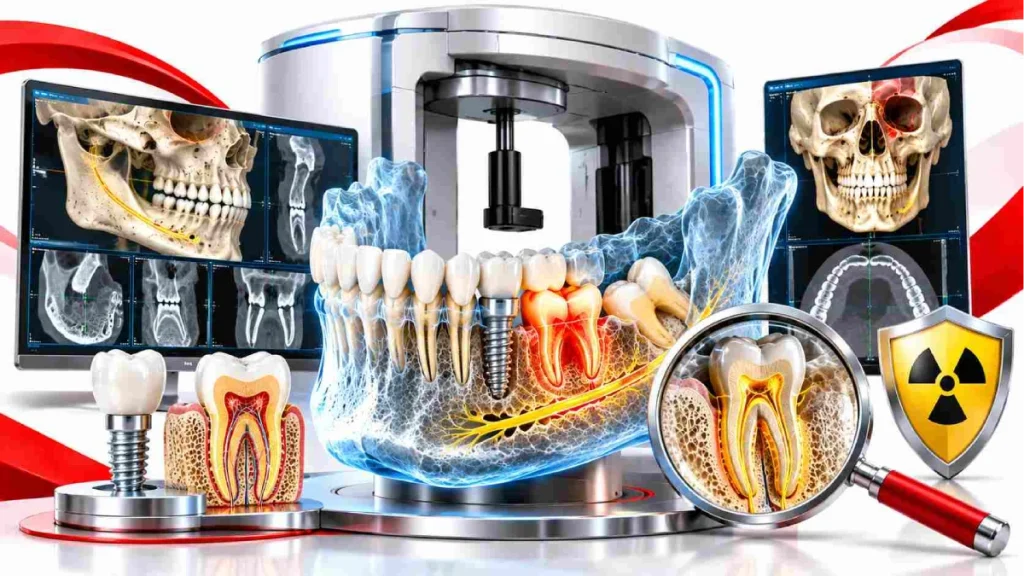
You need a CBCT scan when a regular X-ray cannot explain your problem. You do not need one for routine checkups or cavity checks.
You may need a CBCT scan for:
- Unexplained tooth pain, like pain with a normal X-ray
- Failed root canals, such as swelling after treatment
- Implant planning, like checking bone before surgery
- Impacted teeth, such as lower wisdom teeth near the nerve
- Suspected cracks, like sharp pain when you bite
- Dental injuries, such as a tooth injured in a fall
According to the 2025 AAE and AAOMR joint position statement, CBCT should be used selectively, not routinely. The statement lists 12 clinical recommendations for its use. We order a scan when it can change your treatment plan.
Is a Dental CBCT Scan Safe?
A dental CBCT scan uses ionizing radiation, so dentists recommend it only when the results can help guide diagnosis or treatment. The radiation dose varies based on the scanner, scan area, and exposure settings.
According to RadiologyInfo.org, the approximate effective dose for a cone beam CT scan is 0.18 mSv. This is an average reference value, not the exact dose for every scan. We use the smallest scan area and lowest settings that provide enough detail for diagnosis.
Tell us if you are pregnant or think you may be pregnant before the scan. We will assess whether the scan is necessary or whether it can be safely delayed.
What to Expect During Your CBCT Scan
During a dental CBCT scan, you sit or stand still while the machine circles your head. Before the scan, you remove metal items, like earrings, glasses, dentures, and hearing aids. You bite on a small holder, and the machine is open and does not require you to enter a tunnel.
After the scan, we review the 3D images with you, often at the same visit. You can ask for a copy as DICOM files for a second opinion.
Book Your Dental CBCT Scan
To book a dental CBCT scan in Boca Raton, call Toothsavers at (561) 368-3636. Our office is at 900 Glades Road, Suite 3A, Boca Raton, FL 33431.
As endodontists, we use CBCT to find problems like hidden infections, missed canals, and cracked roots. If a scan won’t change your treatment, we will tell you that too.
Read more about our CBCT dental scans, or schedule your appointment online . If tooth pain won’t go away, don’t wait to get it checked.
FAQs
How much does a dental CBCT scan cost?
A dental CBCT scan costs about $150 to $350 without insurance in many U.S. offices. The price depends on the scan size and whether a radiologist report is needed.
Does insurance cover a CBCT scan?
Most dental plans do not cover CBCT scans, but medical insurance may. Medical plans may pay when the scan is for an injury, a growth, or a sinus problem.
Does a CBCT scan hurt?
No, a CBCT scan is painless and nothing enters your body. You stay still for less than a minute while the machine turns around your head.
Can CBCT replace regular dental X-rays?
No, CBCT does not replace regular dental X-rays. Bitewing and panoramic X-rays remain the right tools for routine checkups.
Can CBCT detect cavities?
CBCT is not a good tool for finding cavities. Metal fillings and crowns cause streaks, so bitewing X-rays work better for tooth decay.
What field of dentistry benefits most from CBCT imaging?
Endodontics, implant dentistry, and oral surgery benefit most from CBCT imaging. These fields need exact views of roots, bone, and nerves, like the inferior alveolar nerve.
Can a CBCT scan detect a dental infection?
A CBCT scan can reveal signs of infection around tooth roots and in nearby jawbone structures. It can also show whether a lesion extends toward the maxillary sinus.