CBCT scans give us a detailed 3D view of your teeth, jawbone, nerves, and nearby tissues that a regular flat X-ray can’t fully show. If we’ve recommended one as part of your care, you likely have questions about why you need it, how it works, and what happens during your visit. Below, we explain in …

CBCT scans give us a detailed 3D view of your teeth, jawbone, nerves, and nearby tissues that a regular flat X-ray can’t fully show. If we’ve recommended one as part of your care, you likely have questions about why you need it, how it works, and what happens during your visit. Below, we explain in simple terms what a CBCT dental scan involves, why it may be part of your treatment plan, and what to expect before, during, and after it.
What Is a CBCT Dental Scan?
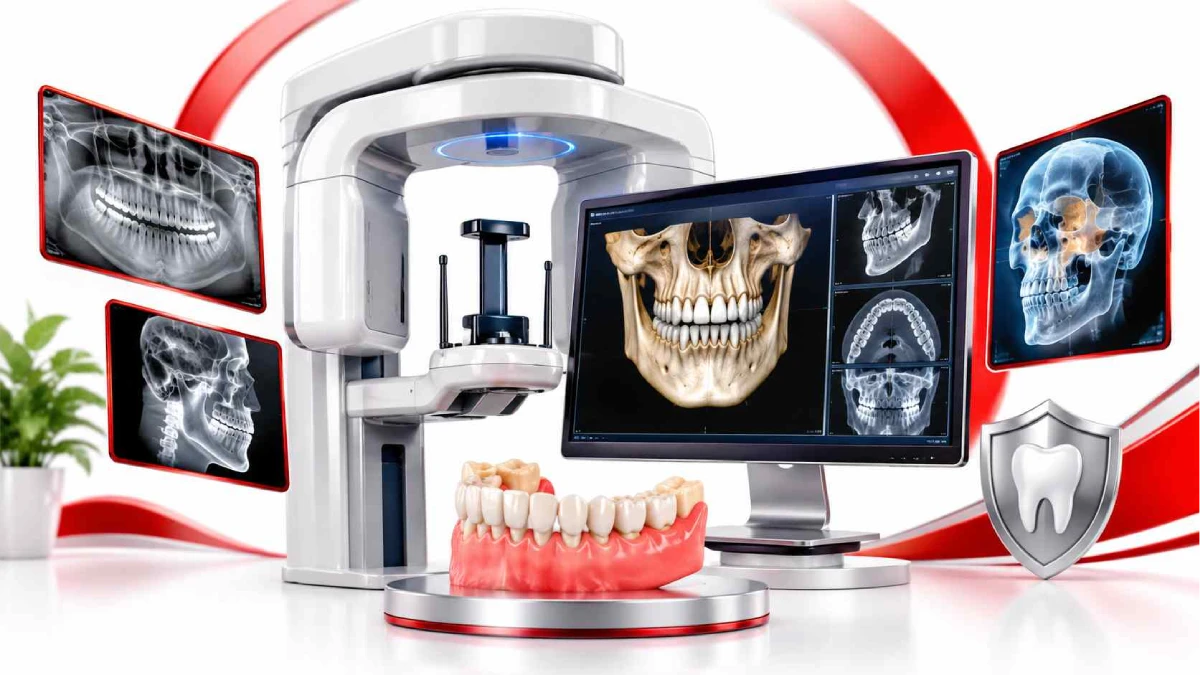
A CBCT dental scan is a 3D X-ray that shows your teeth, jawbone, nerves, and sinuses from every angle. The name stands for cone beam computed tomography. A standard X-ray works like a photograph, with everything pressed into one flat layer. A CBCT scan is closer to walking around a statue, so nothing stays hidden behind something else.
During the scan, an arm circles your head while you stand or sit still. It takes hundreds of images along the way, and software stacks them into a 3D model. We can scroll through this model slice by slice, like pages in a book. The scan collects all the data in one rotation, typically in 10 to 40 seconds.
The scan size depends on what we need to see. It can cover one or two teeth, one jaw, or both jaws. For example, a root canal check may need a small view, while implant planning needs a wider one.
How Is CBCT Different From Regular Dental X-Rays?
A regular dental X-ray gives one flat image, while CBCT builds a full 3D view. On a flat X-ray, teeth, roots, and bone overlap like shadows. A small crack or an extra canal can stay hidden behind them. A 3D scan separates each layer, so we see the exact shape and position.
The way the images are taken also differs. Bitewing and periapical X-rays use a small sensor inside your mouth. A CBCT machine stays outside your mouth and circles your head, taking hundreds of images from different angles.
Regular X-rays remain our first choice for checkups, like finding cavities. We add a CBCT scan when a case needs more detail, like implant planning or a hard-to-diagnose toothache.
Why Would a Dentist Recommend a CBCT Scan?
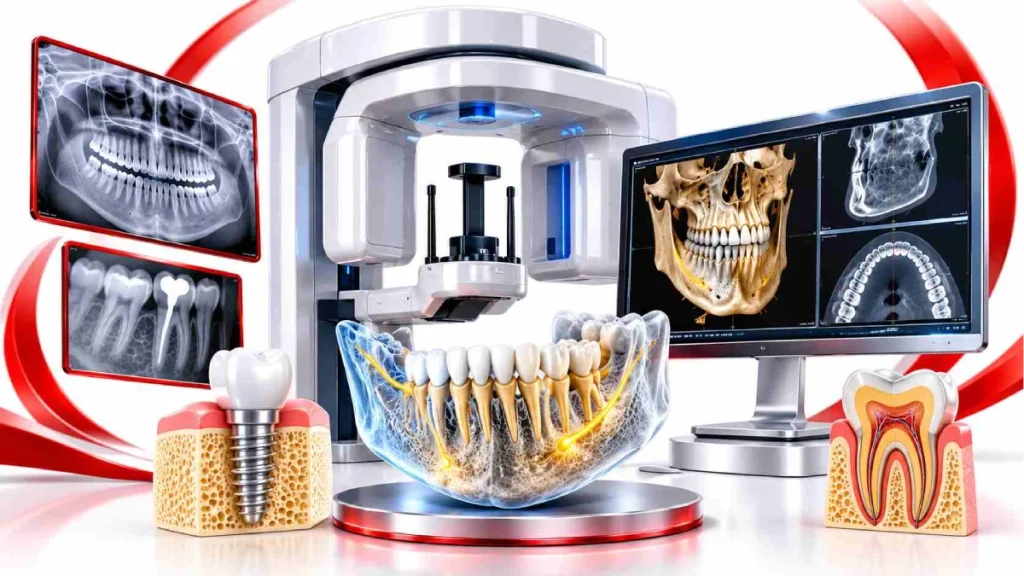
We recommend a CBCT scan when a flat X-ray can’t show enough detail. It isn’t a routine checkup tool. The latest AAE and AAOMR joint statement says CBCT should be used selectively, based on clinical signs, existing images, and patient needs.
Dental Implant Planning
The scan shows your bone height, bone width, and where your nerves and sinuses sit. Your implant surgeon uses these measurements to choose the right implant size.
It also helps avoid the nerve canal in your lower jaw and the sinus floor above your upper teeth. If the bone is thin, you may need a bone graft or sinus lift first.
Root Canals and Unexplained Tooth Pain
CBCT finds problems 2D X-rays miss, like hidden canals, root cracks, and early infections. In one study of root canal retreatment cases, lesions were identified in 41% of roots using single radiographs and 68% using CBCT.
This helps when a tooth hurts but the X-ray looks normal. As a result, we can treat the real cause.
Wisdom Teeth and Oral Surgery
The scan shows how close an impacted tooth sits to nerves and sinuses. Lower wisdom teeth can lie near the inferior alveolar nerve, which gives feeling to your lip and chin.
It also helps oral surgeons plan other procedures, like removing jaw cysts or exposing impacted canines.
TMJ, Orthodontic and Sinus Concerns
A 3D scan shows your jaw joint bones, tooth positions, and sinuses. For jaw pain or clicking, it can reveal bone wear. It doesn’t show the joint disc, so an MRI may be needed.
Orthodontists use it for complex cases, like impacted canines. An infected upper tooth can also feel like sinus pain, and the scan helps us tell the two apart.
What a CBCT Scan Can and Can’t Show
A CBCT scan shows hard structures clearly, like teeth, roots, jawbone, nerve canals, and sinuses. It can reveal root infections, cracks, cysts, bone loss, and impacted teeth. We see their exact size and position.
It shows soft tissue poorly, like gums and the TMJ disc. Metal crowns and implants can blur nearby areas. A small scan covers only the area we choose, so it may not show all your teeth.
The scan may also catch findings outside the mouth, like sinus thickening. If we need a second opinion on the images, we can refer them to an oral and maxillofacial radiologist.
Is a CBCT Scan Safe?
Yes, a CBCT scan is safe when it’s ordered for a clear reason and kept to the smallest area needed. It uses more radiation than a regular X-ray but far less than a medical CT. The ADA recommends using CBCT only when lower-exposure imaging can’t provide the information needed.
How Much Radiation Does CBCT Use?
The dose depends on the machine and the size of the scan area. A small-field dental CBCT gives about 20 to 100 microsieverts, roughly one to two weeks of natural background radiation. A medical head CT gives around 2,000.
Larger scans that cover both jaws use more radiation. That’s why we usually scan only the tooth in question.
CBCT During Pregnancy and for Children
Tell us if you are pregnant or might be. The beam doesn’t point at your abdomen, but non-urgent scans can often wait until after delivery. The ADA no longer recommends lead aprons or thyroid collars for any patient, including pregnant women.
Children are more sensitive to radiation than adults, so dentists lower the dose and avoid scans that aren’t needed. Common reasons for a child’s scan include impacted canines and complex orthodontic cases.
How to Prepare for Your CBCT Scan
Preparing for a CBCT scan is simple: remove metal items and eat as usual. You don’t need to fast or change your regular medicines.
Metal blurs the images, so take off earrings, piercings, glasses, hearing aids, hairpins, and removable dentures or retainers. Wear clothes without zippers or snaps near your neck.
Let our team know if you feel anxious or have trouble standing still. Bring any recent dental X-rays, since they may save you an extra scan.
What Happens During and After a CBCT Scan?
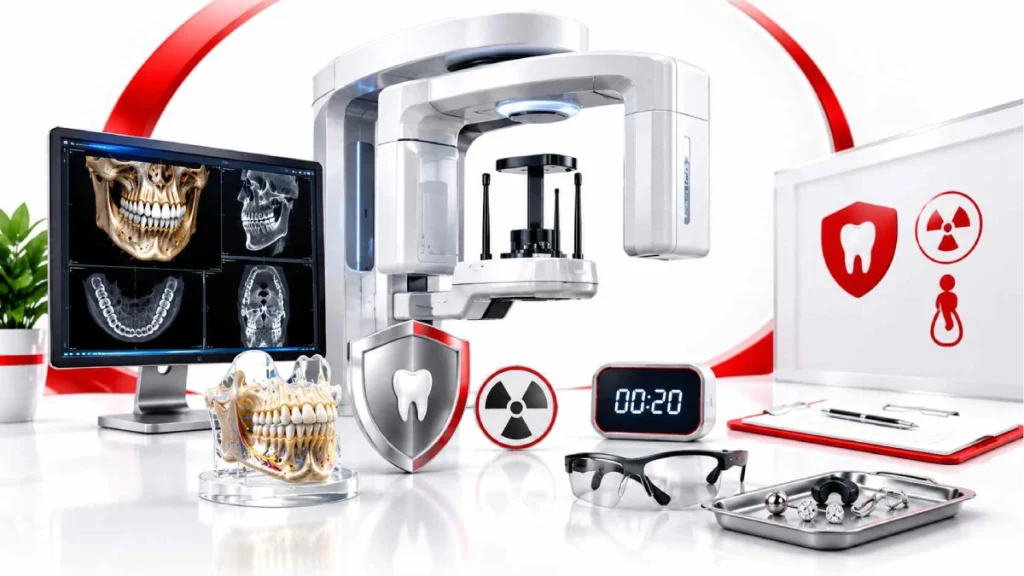
During a CBCT scan, you stand or sit still while the machine turns once around your head. You’ll rest your chin on a support and bite gently on a small guide. The scan takes under a minute, and the full visit usually lasts 5 to 10 minutes.
There are no needles, no dye, and no enclosed tube. You can go back to normal activities right away. Afterward, we review the 3D images and explain the findings, often at the same visit. You can also ask us for a digital copy of your scan to share with other providers.
How Much Does a CBCT Scan Cost?
A dental CBCT scan typically costs between $150 and $600. The price depends on the scan size, your location, and whether it’s done at a dental office or an imaging center.
Some offices include the scan in the treatment fee, like for implant cases, while others bill it separately. Dental insurance may cover part of it when the scan is medically necessary. Medical insurance sometimes pays for TMJ or sinus scans. Ask for a cost breakdown and check your coverage before your visit.
Questions to Ask Us Before Your CBCT Scan
Ask us why you need the scan, what area it covers, and how the results will shape your treatment. Clear answers help you feel confident and avoid imaging you don’t need.
- Why do I need a CBCT scan instead of a regular X-ray? We’ll explain the specific question the scan will answer.
- What area will you scan? A small scan of one or two teeth uses less radiation than a full-jaw scan.
- Can you use my previous X-rays or scans? Recent images from another office may save you a repeat scan.
- Who will review the full scan? Ask whether our team or a radiologist will read it.
The Bottom Line on CBCT Scans
A CBCT scan gives us a clear, three-dimensional view of your teeth, roots, jawbone and nerves, details that a standard X-ray can miss. When a tooth problem is hard to diagnose, or when you need a root canal, retreatment or surgery, that extra clarity helps our team plan your treatment with more precision and confidence. Not every patient needs a CBCT scan. When we recommend one, it’s because the images can answer questions that other imaging can’t.
Before your scan, feel free to ask us what we’re looking for and how the results could affect your treatment options. Let us know about any recent dental X-rays or a possible pregnancy, and bring past records if you’re a new patient or getting a second opinion. The scan itself is quick, and we’ll walk you through what the images show so you can make informed decisions about your care.
Have questions about a CBCT scan or wondering if you need one? Call (561) 368-3636 today to speak with us, or visit toothsavers.net to learn more.
FAQs
What Are the Risks of a CBCT Scan?
The main risk is a small dose of radiation, which is higher than a regular dental X-ray but much lower than a medical CT. We keep this risk low by scanning only the area needed and only when a 2D X-ray can’t answer the question.
Is There Anything I Shouldn’t Do Before a CBCT Scan?
Don’t wear metal items like earrings, piercings, hairpins, or removable dentures, because metal blurs the images. You don’t need to fast or change your regular medicines, so eat and drink as usual.
What Can a CBCT Dental Scan Reveal?
A CBCT scan can reveal root infections, cracks, extra canals, bone loss, cysts, and impacted teeth. It also shows the position of nerves and sinuses, which helps with root canal, implant, and surgery planning.
Can CBCT Show Infection?
Yes, CBCT can show infection at the root tip, often before it appears on a regular X-ray. It shows the bone damage the infection causes, which helps us find the exact tooth and root involved.
Does a CBCT Scan Hurt?
No, a CBCT scan doesn’t hurt. You stand or sit still for under a minute, with no needles, dye, or enclosed tube.
Do I Need a Referral for a CBCT Scan?
It depends on where you get scanned. Imaging centers often ask for a referral from your dentist, while offices with their own scanner, like ours, can take it during your visit.
How Often Is It Safe to Have a CBCT Scan?
There’s no fixed number, because each scan should have a clear clinical reason. We check your recent images first and order a new scan only if it will change your treatment.
Can I Get a Copy of My CBCT Scan?
Yes, you can ask us for a digital copy of your scan, usually as a DICOM file. It’s useful if you need to share it with your dentist or another specialist.